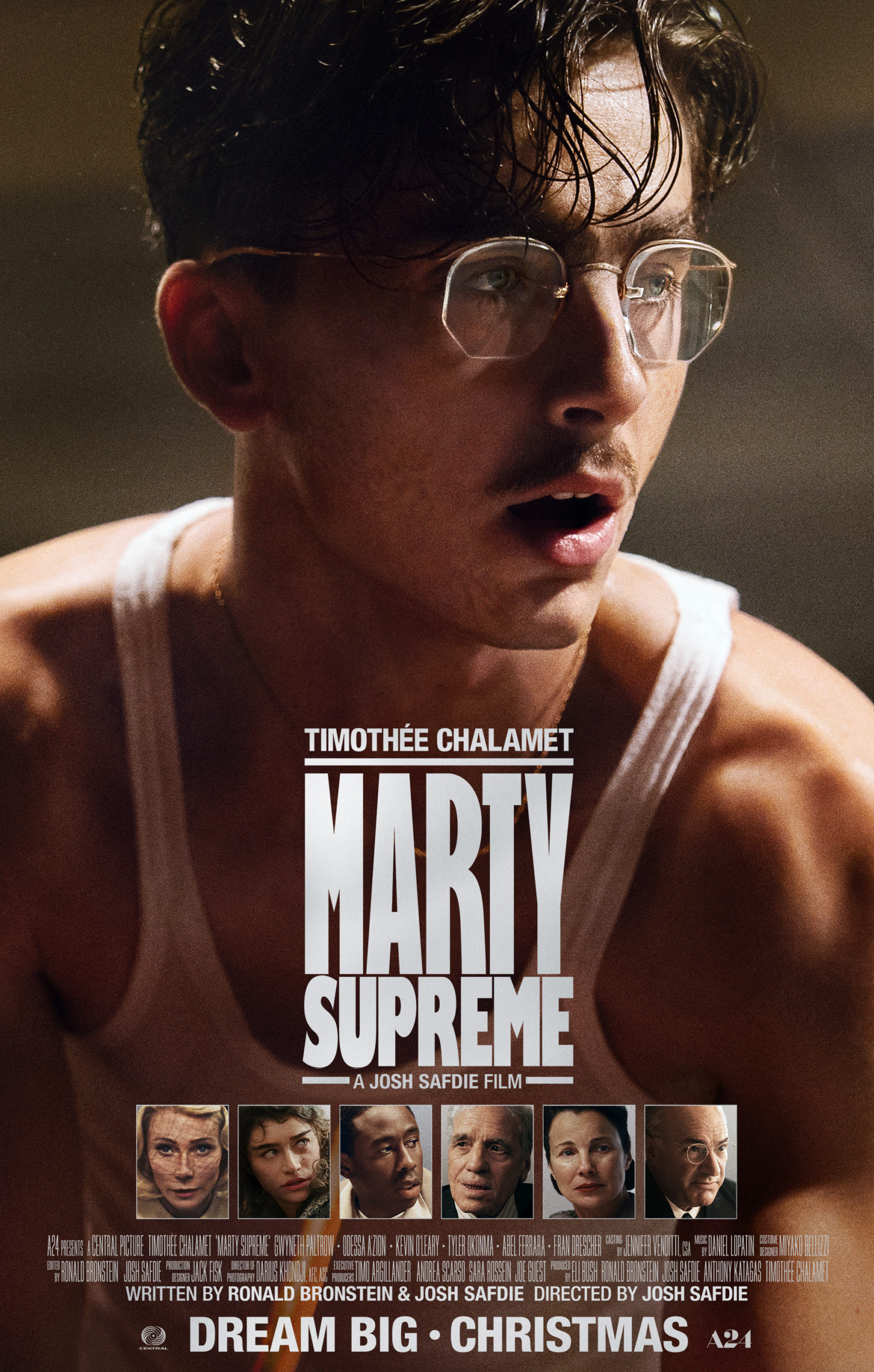
Director Josh Safdie takes a ping pong story and spins it into a film with an anti-capitalist, anti-American exceptionalism message at its core.
By Craig Allan
Four stars out of five. See it.
As the American brand of capitalism seems to degrade annually, films are questioning whether it was ever good to begin with. Set in 1952, Marty Supreme (MS) follows Marty Mauser (Timothée Chalamet) as he tries to become the world’s greatest table tennis player. Though the film may look like a table tennis movie on the surface, it is actually about the way capitalism poisons our collective dignity and how American exceptionalism blinds people into believing that becoming the best is the totality of success in life.
Safdie’s script, co-written and edited with Ronald Bronstein, is rich with themes of hustling and anti-capitalist ideals. These are themes that have been echoed in other projects Safdie has done with his brother, Benny Safdie, like Good Time and Uncut Gems. Marty is a cocky individual who believes he can be the best table tennis player in the world; however, his desires seem to be based more on the fame of being at the top of the podium than on the money he could make. This is fame that Marty can gloat over as he poses for Wheaties boxes. He is entirely selfish and dangerously full of himself, and in his vanity, he represents America on the world stage both now and in the latter half of the twentieth century. Marty wants to be the best, but he is being crushed by the realities of life in a capitalist society. He thinks that he can hustle and scam his way out of his problems, and he will learn that he can’t.
Chalamet has had a lot of great performances in his short time in the spotlight, and MS is his best performance yet. Chalamet delivers as an overconfident man who will use every person he comes across in order to get ahead. You can see the ever-growing desperation in Marty as the movie goes on, but his brash nature is present throughout. Marty sees himself as almost a folk hero, but compared to Japanese people who had atom bombs dropped on them and concentration camp survivors who sacrificed to try and save others, Marty looks pathetic. Chalamet is amazing here, giving his all in a committed performance, creating a decent chance that he may have rallied the Best Actor Oscar nod in a “Brando-esque” performance. Another surprising performance is by real-life millionaire Kevin O’Leary, who plays millionaire pen entrepreneur Milton Rockwell, and Marty’s benefactor. Considering how anti-capitalist this movie is, it is surprising that O’Leary would appear in a film that, in a meta way, insults everything that he represents in real life. O’Leary is basically playing his “Mr. Wonderful” persona established on Dragon’s Den/Shark Tank, but in a movie.
This is Safdie’s first film directed without his brother, and he has proven to be up to the task. Safdie’s direction is stellar, as he makes MS feel like a gritty 70’s film. The sets look incredible, and Safdie does not shy away from showing the ugly parts of his subject. You can see every pore and scratch on Marty’s face and every freckle and beauty mark on everyone else. This is an ugly film in the best way, especially in the 70mm version that I saw.
The tagline for this movie is “Dream Big,” but this tagline is misleading. It is the act of dreaming big that is cursing Marty into complacency. It is only at the end of the movie (no spoilers) that he realizes what really matters. Along with a great score by Daniel Lopatin, editing, and some standout performances by Odessa A’zion, Tyler Okonma, and Luke Manley, MS is an absolute tour de force movie that goes in wildly different directions than expected. A repeat viewing is in store for me, as I am sure I did not catch every subtle thematic reference in this movie, but MS serves up one of the best films of 2025 and has set itself up as a supreme Oscar contender.