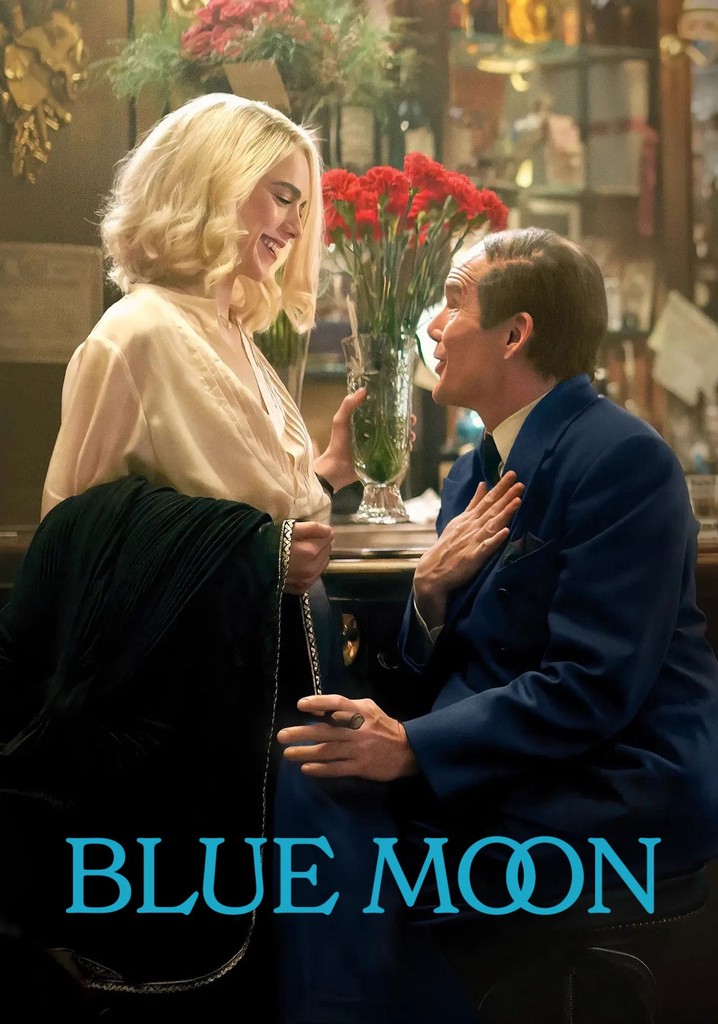
Director Richard Linklater and Ethan Hawke come together again for a funny and beautiful film about scorned partners, desire, and eccentricities.
By Craig Allan
Four and a half stars. See it.
Everyone feels moments in life where there is a feeling of betrayal. Whether it is from a relationship gone south or a partnership that has run its course, it can be fraught with emotions, especially if one half goes on to great success. This is the situation chronicled in director Richard Linklater and Ethan Hawke’s new film Blue Moon (BM), a film about Lorenz Hart (Hawke), the original partner of famed musical writer Richard Rodgers (Andrew Scott), before he paired up with Oscar Hammerstein (Simon Delaney). Taking place almost entirely within the famed Sardi’s restaurant in New York City on March 31, 1943, the movie follows the eccentric Hart as he grapples with the horrible truth that he has been replaced. At the same time, he is swooning over a young college student, Elizabeth Weiland (Margaret Qualley), whom he believes might have feelings for him. Packed to the brim with whip-smart dialogue that is both funny and devastating, Blue Moon is an absolute riot and one of the best films of the year. With Hawke carrying the film, it might just secure him his elusive Oscar.
Hawke had to be in every scene for this movie, remembering long stretches of fast, complicated stories and anecdotes which he handles in spades. Diatribes on Rogers and Hammerstein’s Oklahoma! being horrible due to the exclamation point at the end and waxing poetically about the beauty of a half-erect penis being some of the funniest asides as Hart grapples with his midlife crisis. Hawke never ceases to be amazing and funny as the increasingly desperate Hart. The movie hangs on every word he says, and the movie is enjoyable because you have no idea what off-kilter comment Hart is going to make. While actors like Michael B. Jordan, Leonardo DiCaprio, and Timothee Chalamet may be in more high-profile films, Hawke is making a serious play as a spoiler for the Best Actor Oscar. This was a movie Hawke was originally scared to make due to how much dialogue was involved, so the script, written by novelist Robert Kaplow, sat around for years before Hawke was willing to take on the project. The dialogue is superb, and while this may not be as weighty a project as some of Linklater’s other films, it is still some good work from one of the industry’s best small-scale directors.
The only negative for the film could be its ending. While the movie is not very long, an ending in which Weiland tells a story of unrequited love does slow the frenetic pace simply because it is Weiland telling a story, and Hart just listening. We get less of Hart’s emotionally funny dialogue in this moment, and the fact that it goes on for a while doesn’t help.
This is a small picture, but what it lacks in size it makes up for in the performance of Hart. In a cinema landscape of big-budget fare, BM is a refreshing diversion into a chamber play that shows what happens when a great actor and great dialogue are put in a space and left to run wild. With movie budgets getting larger and making the theatrical experience more of a premium outing, BM is a once in a blue moon film that shows movie magic is not limited by budget when someone like Hawke is strutting around the set. How can so much talent be contained in small strips of celluloid?