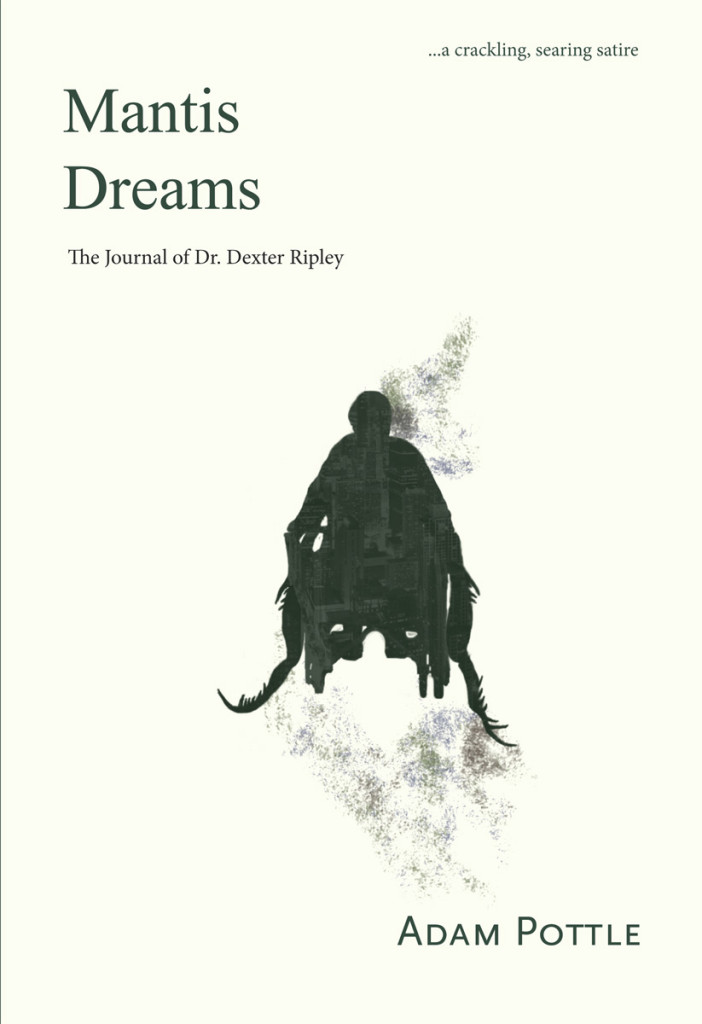
‘Mantis Dreams’ review
By Joshua Grant, Columnist
2/5
Adam Pottle’s Mantis Dreams is written as the journal of Dr. Dexter Ripley, an English professor confined to a wheelchair with Charcot-Marie-Tooth disease. Since his diagnosis, Ripley has become one of the world’s foremost scholars in disability studies, and also happens to be a bitter, self-obsessed jerk. Pottle creates a character who is disabled but steadfastly unsympathetic.
The novel’s title comes from Ripley’s dreams about bounding over the city in the form of a giant praying mantis crushing buildings. This is a common dream symbol that represents something that looks harmless (Ripley’s disabled body) but is about to attack (Ripley’s attitude). His personality is a slave to his philosophy, stitched together from a range of contemporary disability scholars. He refuses treatment. He tells crude disabled jokes. Some of his colleagues say that he uses his disability as a career prop to transfer from the overcrowded field of British literature to disability studies, where he hopes to redefine disability as a type of strength.
With the journal structure, one might hope to get some sympathetic complexity out of the character, but he’s nearly as arrogant on the page as he is to those who care for him. In this short novel, he abuses a homeless man, his students, his sister, and the staff and residents at his assisted living facility.
This is a gutsy move on the author’s part. There’s definitely something interesting about a wholly awful protagonist, like Patrick Bateman in Bret Easton Ellis’s American Psycho, but it makes Mantis Dreams a challenging and largely unsatisfying read. It’s a relentlessly negative, 219-page-long sneer, broken up by dark humour and defiant insights.
Mantis Dreams might interest those interested in the politics of disability, but I doubt it will delight.
