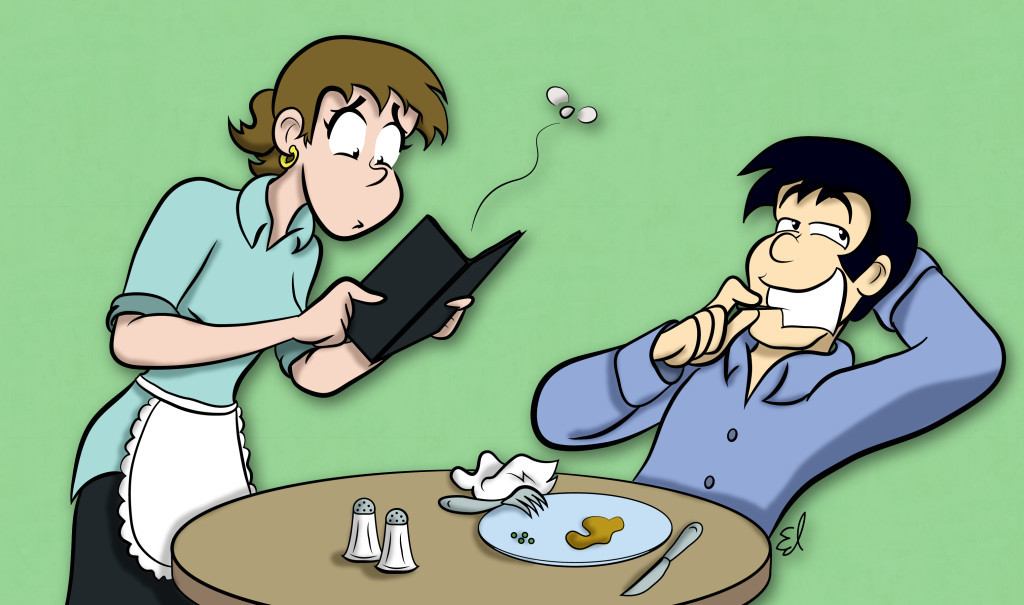
Do customers get what they pay for when they tip?
By Cazzy Lewchuk, Staff Writer
Let’s face it: tipping sucks.
Nobody enjoys tipping. No one likes to give an extra fee in addition to their service, whether it be a meal, haircut, or just a drink at the bar.
Yet almost every service expects a tip nowadays. Waiters, bartenders, concierges, casino dealers, deliverers, and even doormen are all supposed to receive a couple of extra dollars on top of the bill for simply doing their job. Some jobs aren’t even allowed to accept tips, but tipping has become more and more commonplace and expensive. It’s a societal requirement, and the non-tipper is hated by servers and customers alike.
Is tipping generous? Not really. Since it’s considered mandatory, giving a tip is nothing more than an extra fee to receive adequate service. Someone who doesn’t leave a tip—or even a small one—will definitely receive lower service quality on their next visit. It’s extortion, in a sense.
Even when people do tip, it’s usually not done for the reason tipping exists: to reflect good service. Tipping tends to reflect the bill. A customer who tips 15 per cent on a $100-bottle of wine will be giving a $15-tip, compared to the customer who gave 50 per cent on $10 for a burger and fries (a tip of $5). The $5 customer is much more generous, but the $15 one will be seen as the biggest tipper.
Tipping is not deserved in many cases. Does it reflect labour? Not usually. There’s often a tip jar at coffee shops—am I really supposed to give extra money to the staff just because they filled up a $3-cup of coffee and handed it to me? Same at the bar: tipping an extra dollar or two on a $5-beer quickly adds up. But giving a small tip—or no tip at all—will almost guarantee you’ll be served last. This is despite the fact that serving drinks is literally the bartender’s entire job. Why must we reward them no matter what the quality of the service? Even adequate or bad service demands a tip nowadays, even if it’s a small one. Only in truly terrible service is it acceptable to leave no tip. Yet if a server isn’t doing their job properly, they still get paid the same wage—they simply won’t make extra money.
Many jobs are just as hard as serving, but there is no social custom for tipping. A McDonald’s employee or a Safeway cashier are working at a quick pace for many customers during peak hours. They’re working hard, because that’s the point of their jobs. Despite this, tipping anyone in retail is almost unheard of, and in many cases against store policy. Most minimum wage workers aren’t lucky enough to have a job that offers tips. Taxi drivers, waiters, and hairdressers all make at least the minimum wage, but they’re making extra out of the pockets of customers.
Is the solution to raise the minimum wage? Almost definitely, although that’s a complicated issue. A wage increase (particularly at restaurants) would maybe see a small increase in the prices, but the payment overall would likely still be lower due to the absence of tips. Higher prices also wouldn’t matter as much if everyone was making more money. In most countries outside of North and South America, this is exactly what happens—tipping is unheard of, and even offensive in some cases. Those who do exceptionally may take a small gratuity on the bill, but providing adequate service (which is the job description) isn’t enough to make an automatic 15 per cent. Why can’t the prices just be higher? Every other service pays their employees a higher wage and reflects this in the cost of their services. Why restaurants and other establishments don’t make this normal, I’ll never know.